
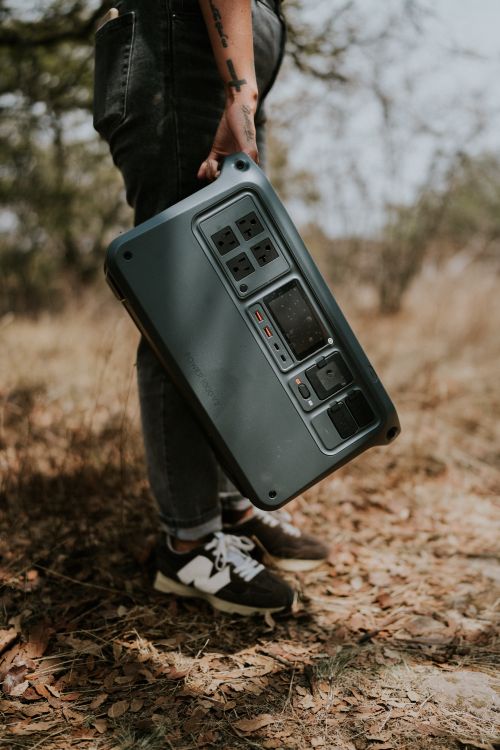
A decade ago, “backup power” meant a gas generator on the patio and a can of stabilizer in the garage. Today, a battery the size of a cooler can run your fridge through an outage, power a campsite for a weekend, or keep a CPAP running all night — silently, indoors, with no fumes and no maintenance. The technology crossed a real threshold in the last two years, and the best portable power stations 2026 has on shelves are cheaper, faster-charging, and far longer-lived than what was selling for the same money in 2023.
This guide covers how to size one correctly (the step most people get wrong), what actually changed in the technology, and the standout picks from Anker, Jackery, EcoFlow, and Bluetti at every capacity level.
First: How to Size a Power Station (Wh vs. W, in Plain English)
Two numbers define every power station, and confusing them is the #1 buying mistake:
- Watt-hours (Wh) = the size of the tank. How much total energy is stored. A 1,000Wh unit can run a 100W load for roughly 10 hours (minus 10–15% conversion losses).
- Watts (W) = the size of the pipe. How much power it can deliver at once. If your appliance needs 1,500W and the station outputs 1,000W, it won’t run at all — no matter how big the battery is.
Some real-world reference points: a phone charge is about 15Wh, a laptop 60Wh, a 12V fridge draws 40–60W running, a full-size fridge 100–200W running (with a brief startup surge several times higher), a CPAP 30–60W per night of use, a microwave 1,000–1,500W, and a space heater or electric kettle 1,500W+. Roughly speaking: 300–500Wh covers devices and lights for a weekend, 1,000Wh runs a fridge through a day-long outage plus everything else, 2,000Wh+ handles multi-day outages, and 4,000Wh with 240V output starts to genuinely replace a standby generator.
What Changed: The LiFePO4 Revolution
Nearly every serious 2026 model now uses LiFePO4 (lithium iron phosphate) cells instead of the older NMC lithium chemistry. The difference isn’t subtle: LiFePO4 packs are rated for 3,000+ full charge cycles (versus roughly 500–1,000 for NMC) — call it ten years of regular use before meaningful degradation — and the chemistry is significantly more heat-tolerant and fire-resistant. Charging speeds transformed too: the current generation refills from a wall outlet in under 90 minutes, with the fastest units doing it in under an hour. Buying advice that was standard three years ago (“treat the battery gently, expect to replace it”) is simply obsolete.
Best Portable Power Stations 2026: The Picks
Best Overall: Anker Solix C1000 Gen 2
The Anker Solix C1000 Gen 2 (~$449) is the consensus winner of the most useful category — the 1kWh class — and it isn’t close. You get 1,024Wh of LiFePO4 capacity, a full 2,000W of AC output (3,000W surge) that runs almost any single household appliance, ten ports, and the fastest charging in the class: zero to full in about 49 minutes. At 24.9 lbs it’s genuinely carryable with one hand. Testers at OutdoorGearLab and elsewhere named it best overall for 2026, and the formula is simple: nothing else combines this much output, this charge speed, and this price.
Buy it if: you want one unit that covers outages, camping, and tailgates without overthinking it. Skip it if: you need multi-day capacity — see the Jackery below.
Best Capacity per Pound: Jackery Explorer 2000 v2
The Jackery Explorer 2000 v2 packs 2,042Wh into 39 lbs — double the capacity of the Anker for only about 14 more pounds, which is the best power-to-weight math in the mid-size field. It’s the pick for multi-day off-grid camping and for households where a fridge, a chest freezer, and device charging all need to survive a two-day outage. Jackery’s build quality and long track record in this category count for something too — they effectively invented it.
Buy it if: capacity is the priority and 39 lbs is still liftable for you. Skip it if: you’d realistically never use more than half of it — the C1000 Gen 2 costs much less.
Best Ecosystem: EcoFlow Delta 3 Plus
The EcoFlow Delta 3 Plus (1,024Wh, 2,400W output) matches the Anker on paper and beats it on ports and peak output — but the real reason to choose EcoFlow is the ecosystem. No one else’s software and smart-home integration comes close: expansion batteries, smart home panels, generator integration, even EV-to-home charging interfaces all live in one app. If a power station is step one of a larger home-energy plan, EcoFlow is the platform to build on. For a cheaper entry point, the River 2 Pro (768Wh) remains the standout small unit — TechRadar’s long-running top pick for its 70-minute charge and port selection.
Buy it if: you want the smartest software and a clear expansion path. Skip it if: you just want a battery — the Anker is faster to charge and usually cheaper.
Best for Home Backup: Anker Solix F3800 Plus
The Anker Solix F3800 Plus is where “portable power station” starts to mean “generator replacement.” It’s built for the big jobs — large RVs, mobile air conditioning, and whole-circuit home backup — with 240V split-phase output that can run the appliances smaller units can’t touch (well pumps, dryers, central HVAC with the right setup) and expansion-battery support that scales the capacity into the tens of kilowatt-hours. It rolls on wheels rather than carrying, and it costs accordingly — but against the standby generator it replaces, it’s silent, fumeless, and needs no fuel run.
Buy it if: you’re solving outages for the whole house or powering an RV. Skip it if: it would spend its life running a mini-fridge — this is heavy artillery.
Also Worth a Look: Bluetti Elite 200 V2
The Bluetti Elite 200 V2 (~$1,699, 2kWh class) is a legitimate workhorse — it wall-charges faster than its direct competitors and takes up less shelf space per watt-hour. The caveat from lab testing: its efficiency running small loads (a phone charger, a lamp) trails Anker and EcoFlow noticeably, which matters if your typical use is trickling small devices rather than running real appliances. Strong choice for camping and emergency duty at the right sale price.
The Comparison Table
| Model | Capacity | AC Output | Weight | Full Recharge | Best For |
|---|---|---|---|---|---|
| Anker Solix C1000 Gen 2 | 1,024Wh | 2,000W (3,000W surge) | 24.9 lbs | ~49 min | Most people |
| EcoFlow Delta 3 Plus | 1,024Wh | 2,400W | ~28 lbs | ~56 min | Smart-home ecosystem |
| EcoFlow River 2 Pro | 768Wh | 800W | ~17 lbs | ~70 min | Budget / small loads |
| Jackery Explorer 2000 v2 | 2,042Wh | 2,200W | 39 lbs | ~102 min | Multi-day capacity |
| Bluetti Elite 200 V2 | 2,073Wh | 2,600W | ~53 lbs | ~90 min | Fast-charging 2kWh class |
| Anker Solix F3800 Plus | 3,840Wh (expandable) | 6,000W / 240V split-phase | Wheeled | Varies by input | Home backup, RV |
Specs per manufacturer listings and independent lab testing as of mid-2026; weights rounded. Recharge times are AC wall charging at maximum rate.
Don’t Skip the Solar Question
Every unit here accepts solar input, and it changes what the product is: with a 200–400W panel, a power station stops being a battery you drain and becomes a system that refills itself every day the sun is out. For outage kits it’s the difference between “two days of fridge” and “indefinite fridge.” Panels are usually cheapest bought in a bundle with the station — worth pricing both ways before you check out. A 200W folding panel is the sweet spot for the 1–2kWh units above.
Practical Ownership Notes
- Store at 50–80% charge, not full — it’s easier on the cells for long-term storage, and LiFePO4 self-discharges slowly enough to top up quarterly.
- Mind the surge rating. Fridges, pumps, and anything with a compressor briefly demand several times their running wattage at startup. The surge spec (not the rated output) determines whether they start.
- Don’t leave it baking in a car. LiFePO4 tolerates heat far better than older chemistries, but a 140°F trunk still shortens its life.
- Retiring an old NMC unit? Don’t put it in the trash — lithium batteries are exactly what battery-recycling programs exist for. Here’s the right way to recycle old electronics.
- Boaters: a mid-size unit is a superb dockside/anchorage supplement to house batteries — one more thing to factor into the budget from our first-catamaran buying guide.
The Bottom Line
For most households, the answer is the Anker Solix C1000 Gen 2 — enough output to run any single appliance, enough capacity for a real outage, charged faster than you can finish unloading the groceries. Go Jackery 2000 v2 when capacity is the mission, EcoFlow when you’re building toward a smart-home energy system, and F3800 Plus when the goal is retiring a gas generator entirely. Whichever way you go, add the solar panel — it’s the upgrade that turns a big battery into actual energy independence.
As an Amazon Associate, Infinity City earns from qualifying purchases.