

I used to patch our firewall once a quarter. Set a reminder, block out a maintenance window, done four times a year. In the last three weeks, I’ve patched it three times. That’s not me being paranoid — that’s just how fast the vendor has been shipping fixes. Welcome to patch management in 2026.
If you run anything in IT and it feels like the updates never stop anymore, you’re not imagining it. The patching treadmill hasn’t just sped up in 2026 — it has gone into overdrive, and a big part of the reason is that artificial intelligence is now hunting for bugs faster than humans ever could. That shift has turned patch management into one of the hardest, highest-stakes jobs in IT. Here’s what’s happening, why, and how to keep from drowning in it.
The flood is real: 2026 by the numbers
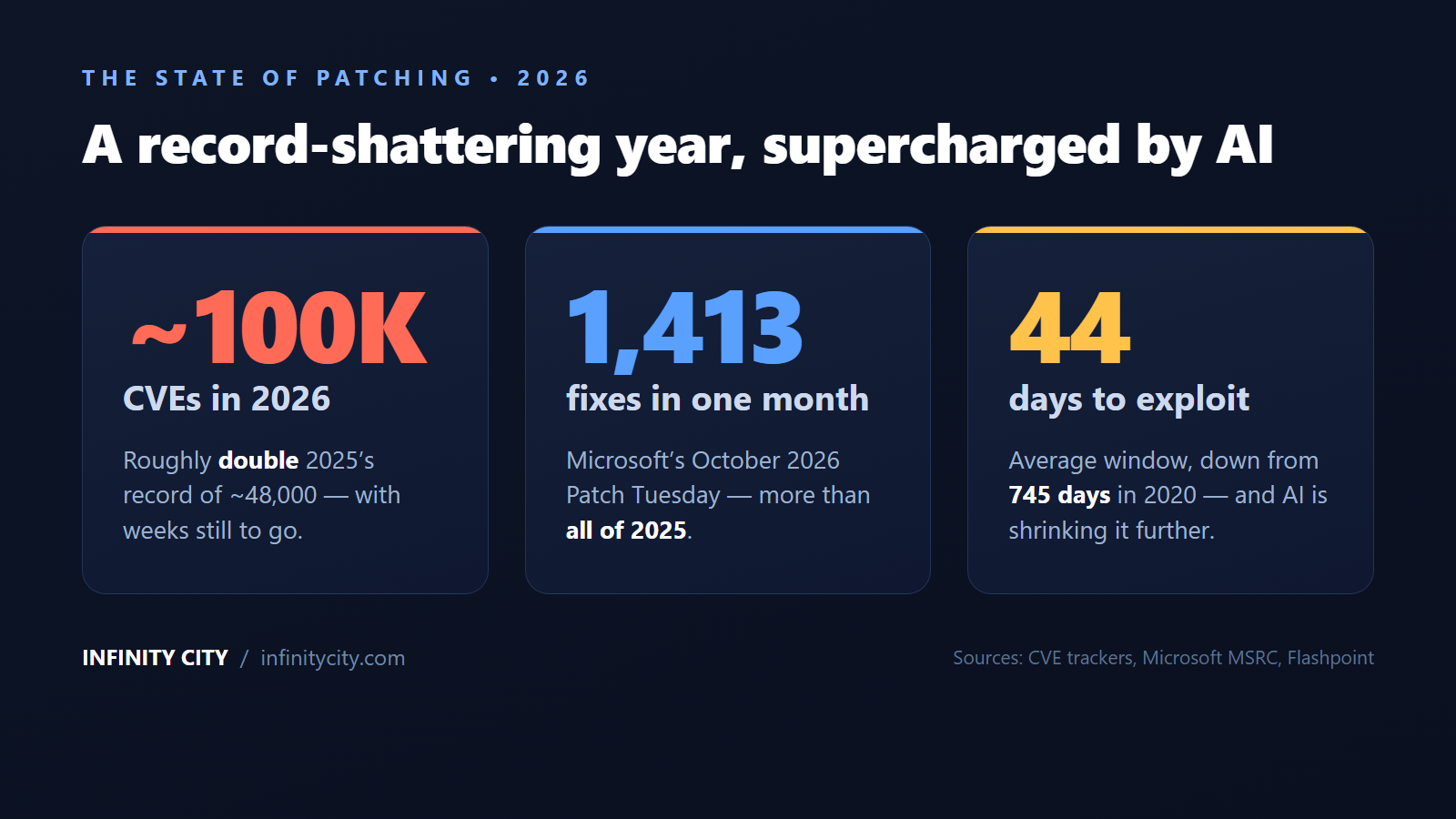
Start with the raw count of disclosed vulnerabilities. A CVE (Common Vulnerabilities and Exposures) entry is the industry’s standard ID for a single security flaw, and the number of them being published has exploded. All of 2025 produced roughly 48,000 CVEs — itself a record at the time. As of mid-November 2026, trackers have logged close to 100,000 CVEs for the year, with weeks still to run. That’s not a bump. That’s roughly double the previous record, in a single year. October 2026 alone saw around 17,000 CVEs published — the busiest month on record, according to one tracker.
Microsoft is the clearest barometer because almost everyone runs its software. In all of 2025, Microsoft patched about 1,130 CVEs. In October 2026 alone, it fixed 1,413 — more in one Patch Tuesday than it shipped in the entire previous year. And the climb through 2026 was relentless: 415 fixes in August, 972 in September, then 1,413 in October. That is the single most important chart in IT operations right now, and it points straight up.
And that’s just one vendor. Add your firewall, your hypervisor, your VPN appliance, your backup software, your browsers, and your phones, and you start to see why “patch once a quarter” quietly became “patch something every week.”
The engine behind it: AI is now hunting bugs at scale
So why did the numbers suddenly go vertical in 2026? Part of it is bookkeeping: more organizations now issue CVEs, and the Linux kernel team alone assigns one to nearly every bug fix — more than 8,000 so far this year. But one of the biggest drivers is that artificial intelligence has become a serious vulnerability-hunting tool — and it’s being pointed at codebases by everyone at once.
Microsoft has been unusually candid about this. Its own security response team credited much of that record October haul to AI-driven discovery, including a new multi-model AI scanning harness that surfaces flaws across its products far faster than human researchers working alone. Microsoft averaged fewer than 100 fixes a month in 2025; in October it shipped more than 1,400. When a vendor can suddenly find that many more bugs, it has that many more patches to ship.
It’s worth being precise about what AI is and isn’t doing here, because the hype runs hot. As Dustin Childs of Trend Micro’s Zero Day Initiative put it, AI is accelerating bug-hunting on both sides of the fence — it isn’t inventing new bugs out of thin air. The flaws were always there in the code. AI is just finding them much faster. And that cuts both ways:
- Defenders win when their vendor’s AI finds a flaw first and ships a patch before anyone’s exploiting it.
- Attackers win when their AI reverse-engineers that patch the moment it’s public and builds a working exploit in hours, before you’ve had a chance to deploy it.
That second scenario is the one that’s reshaping how patching has to work. The age of AI-assisted bug discovery means the gap between “patch available” and “patch weaponized” is now the most dangerous window in security — and it’s shrinking fast.
The real problem isn’t volume — it’s the shrinking window
Here’s the part that changes how you have to think about patching. It’s not just that there are more fixes. It’s that the time between a flaw being disclosed and it being attacked has collapsed.
Flashpoint tracked the average “time to exploit” falling from 745 days back in 2020 to just 44 days in 2025. Qualys measures it even more aggressively and says the number has gone negative — meaning a meaningful share of flaws are being exploited before a patch is even available. Rapid7 found the median time from a vulnerability being disclosed to landing on CISA’s Known Exploited Vulnerabilities list dropped to around 5 days. With AI now compressing the exploit-development step, that window only gets tighter from here.
That’s why my firewall now gets patched the week a fix drops instead of the next time I get around to it. Google’s threat intelligence team counted 90 zero-day vulnerabilities exploited in the wild during 2025 — up 15% from the year before — and nearly half of them targeted enterprise software and appliances like firewalls, VPNs, and gateways. The edge of your network is exactly where attackers are aiming, and they’re getting there fast.
The other cost: when the patch is the problem
Here’s the tension that makes all of this genuinely hard. The shrinking exploit window screams “patch now.” But the faster and more often you patch, the more often the patch itself is what breaks you — and when a vendor is pushing out 1,400 fixes in a month, the odds of a bad one slipping through go up, not down.
This isn’t a theoretical risk. In July 2024, a single faulty content update from security vendor CrowdStrike bricked an estimated 8.5 million Windows machines worldwide — grounding flights, knocking hospitals offline, and freezing payment systems. Worse, it went to every customer at once, skipping the staging controls many IT teams thought they had. Direct losses to Fortune 500 companies alone were pegged at roughly $5.4 billion, the vast majority of it uninsured. One update. One afternoon.
And it keeps happening. Microsoft’s own January 2026 Windows update caused boot failures, sign-in failures, and Outlook hangs, forcing emergency out-of-band fixes — with the nasty wrinkle that Windows’ built-in rollback feature doesn’t work for security updates, so you often can’t simply back a bad security patch out. Even the vendors’ own cloud services aren’t immune: in November 2026, a major Exchange Online outage was traced to a change Microsoft shipped back in July that carried a latent bug for three months. By the time it surfaced, rolling back three months of production changes wasn’t practical, so engineers had to “patch forward” under fire.
That’s the real dilemma IT teams are living with in 2026: patch too slowly and an AI-assisted attacker walks through an open door; patch too recklessly and you take yourself offline. Rushing an untested update into production can cost more than the vulnerability ever would have. The answer isn’t to pick a side — it’s to build a process that lets you patch fast and safely, which we’ll get to below.
The human cost: patch fatigue is a real thing
All of this lands on people, and the people are tired. Sophos surveyed 5,000 IT and security staff in 2025 and found 76% had experienced burnout. Adaptiva’s research found a majority of respondents now consider patching a bigger problem than detecting vulnerabilities in the first place. And in one survey of security leaders, roughly one in five admitted to booking time off or calling in sick specifically to avoid Patch Tuesday. When a single vendor is shipping 1,400 fixes in a month, that dread is entirely rational.
The answer isn’t to grind harder. You physically cannot hand-patch your way through a hundred thousand CVEs a year. The answer is to patch smarter.
How to stay afloat: smarter patch management, not more patching
You cannot patch everything the moment it ships. Nobody can. Good patch management isn’t about patching everything — it’s about patching the right things first. The trick is to stop treating all 100,000 CVEs as equal and focus your limited time on the handful that will get you hit. Here’s what works:
- Prioritize by exploitability, not severity score. A “critical” CVSS score on an internal tool nobody can reach matters less than a “medium” on your internet-facing firewall. Lean on CISA’s Known Exploited Vulnerabilities (KEV) catalog — if it’s on that list, it’s being used against real organizations right now, so it jumps the queue. Pair it with EPSS (Exploit Prediction Scoring System), which estimates the probability a given flaw will be exploited. Those two lists turn an impossible 100,000 into a manageable few dozen.
- Patch your edge first. Firewalls, VPNs, gateways, and anything else with a public IP are where the zero-days are landing. These get patched fast, every time — no exceptions. That’s the lesson I took from my own firewall’s three-updates-in-three-weeks streak. (If you want to see which vendors are worst for this, we broke down which firewalls have had the most unauthenticated vulnerabilities in a separate piece.)
- Automate distribution. The vast majority of organizations are automating or planning to automate patch rollout, and for good reason: manual patching simply doesn’t scale to this cadence. Let tooling stage and deploy during low-impact maintenance windows so you’re not doing it by hand at midnight.
- Stage every patch, and have a rollback plan. This is how you resolve the patch-fast-versus-patch-safe dilemma. Deploy to a small pilot ring first, watch it for a day, then roll out in waves — so a bad update hits 5% of your fleet, not 100%. Back that with a tested rollback path (snapshots, imaging, known-good restore points). And hold your vendors to the same standard: CrowdStrike’s bad update reached every customer at once with no chance to test it first, and the company has since given customers more control over when those updates land. Favor tools that let you decide when an update reaches your fleet.
- Know the difference between patching and remediating. Applying a patch isn’t the same as closing the exposure. Sometimes a mitigation, a firewall rule, or disabling a feature buys you safe time until you can schedule the real fix. Don’t let a missing maintenance window leave you exposed when a one-line config change would hold the line.
The bottom line
The patching treadmill isn’t going to slow down. With AI now finding bugs at scale on both sides of the fence, 2026’s hundred-thousand-CVE year is more likely a new baseline than a peak. But “more patches” doesn’t have to mean “more panic.” The organizations that cope are the ones that treat patch management as a system: accept that you can’t do everything, automatically surface the flaws being actively exploited, patch your internet-facing gear the moment fixes land, stage everything through a pilot ring, and automate the rest so your evenings stay yours.
My firewall going from quarterly to three-times-in-three-weeks wasn’t a glitch. It’s the new normal. The organizations that handle it well aren’t the ones patching the most — they’re the ones patching the right things, fast, and letting the rest wait their turn.
This article was drafted with the assistance of AI and reviewed and edited for accuracy. Vulnerability and outage figures are drawn from public 2024–2026 reporting by sources including the CVE program, Microsoft MSRC, Flashpoint, Qualys, Rapid7, Google Threat Intelligence, Sophos, Adaptiva, and Parametrix.