
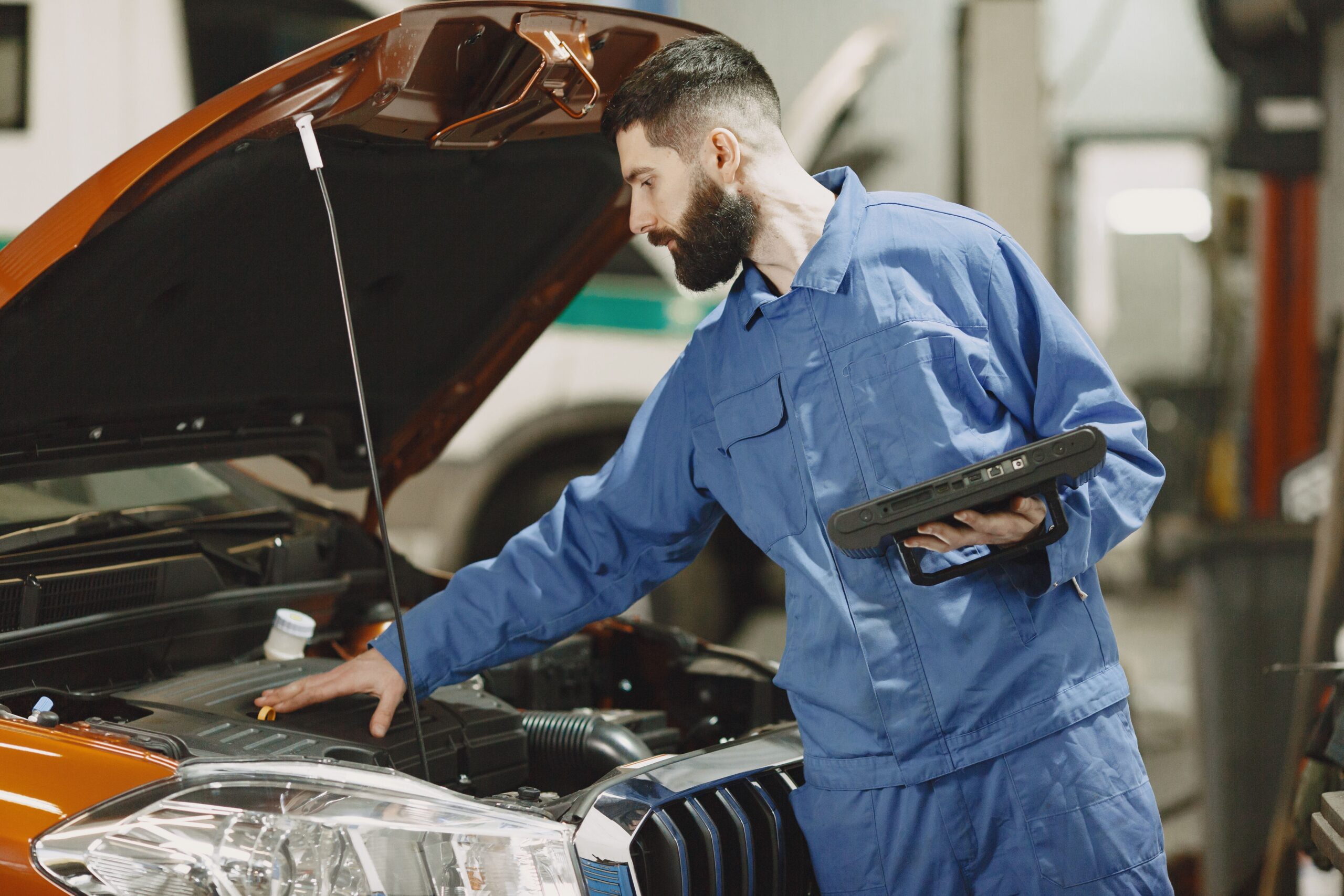
Brake fluid never gets the attention engine oil does, which is backwards — it’s the one fluid standing between your foot and a wall. It’s the hydraulic medium that turns pedal pressure into clamping force at all four wheels, and when it fails, it fails at the worst possible moment: mid-stop. The good news is that checking it takes under two minutes and requires nothing but your eyes. Here’s how to check brake fluid, what the level and color are really telling you, and when a top-off isn’t enough.
How to Check Brake Fluid: Find the Reservoir
Pop the hood and look for a small translucent plastic tank toward the back of the engine bay on the driver’s side, right against the firewall — it sits on top of the master cylinder. It’s marked with a brake symbol (a circle with parentheses and an exclamation point) and has MIN and MAX lines molded into the side, so you read the level without ever opening the cap. On some cars the fluid is a little cloudy through the plastic; a flashlight held to the side makes the level obvious.
Read the Level (and What Falling Level Means)
On level ground, note where the fluid sits between MIN and MAX. At or near MAX is ideal. Here’s the part most guides skip: a slowly falling level is often normal. As brake pads wear thin, the caliper pistons extend further to meet the rotor and hold more fluid, so the reservoir level drops in proportion to pad wear — it’s a rough fuel gauge for your brake pads. That means a level near MIN can simply mean your pads are due, which is worth verifying. What’s not normal is a level that dropped fast, or one you have to keep topping up — that points to a leak, and a leak in a hydraulic brake system is a stop-driving-and-inspect situation, not a top-off.
Read the Color (the More Important Check)
Level tells you quantity; color tells you quality, and quality is what actually fades your brakes. Fresh fluid is clear to pale straw-yellow. Brake fluid is hygroscopic — it pulls moisture out of the air over time, right through the rubber lines and seals — and as it absorbs water and heat-cycles, it darkens to amber, then brown, then something like old coffee. That absorbed water matters enormously: it drops the fluid’s boiling point, and under hard or repeated braking (a mountain descent, towing, a track day) the water can flash to vapor. Vapor compresses where fluid doesn’t, and the result is a soft or sinking pedal exactly when you need it most. Dark fluid is a flush, regardless of what the level says — color trumps level every time.
Know Your DOT Rating
The cap tells you which fluid your car takes — match it exactly:
- DOT 3 — the common glycol-based standard on older and economy vehicles; lowest boiling point of the three.
- DOT 4 — higher dry and wet boiling points, standard on most modern cars and anything with ABS/stability control. DOT 4 can generally top off a DOT 3 system, but not the reverse — check the cap.
- DOT 5.1 — glycol-based like 3 and 4 (despite the number), with the highest boiling points; found on performance cars. Compatible with DOT 3/4 systems.
- DOT 5 — the odd one out: silicone-based, not compatible with the others, and never to be mixed into a normal system. Rare outside classic and military vehicles. If your cap doesn’t say DOT 5, it isn’t DOT 5.
Topping It Off (Correctly)
If the level is low but the fluid still looks clean and you’ve ruled out a leak, you can top it off:
- Clean around the cap first with a rag — any grit that drops into the reservoir contaminates the whole hydraulic system.
- Use fresh fluid from a sealed container in the exact DOT spec on the cap. Never pour from an old, previously-opened bottle — brake fluid absorbs moisture on the shelf too, so an opened bottle is already compromised.
- Add slowly to the MAX line, no higher — the fluid expands with heat and needs headroom. Reseal the cap tightly.
- Wipe any spill immediately. Brake fluid is a paint stripper on contact.
Important limit: topping off restores level, it does not restore old fluid. If the fluid is dark, adding clean fluid to the top just dilutes bad fluid with good — the system still needs a full flush.
Top-Off vs. Flush: Which Do You Need?
Top off when: level is a little low, fluid is clean and light, no leak. Flush (replace all the fluid, usually $80–$150 at a shop) when: the fluid is dark, it’s been more than 2–3 years, you’re prepping for towing or track use, or you just bought a used car with no brake-service history. Most manufacturers call for a flush every 2–3 years regardless of appearance, because moisture content climbs on a schedule the color only partly reveals — which is exactly why brake fluid test strips exist.
Red Flags — Stop Topping Off and Get It Inspected
- You’re refilling repeatedly — that’s a leak (a line, a caliper seal, the master cylinder), not pad wear.
- A spongy or slowly sinking pedal — air in the lines, a leak, or a failing master cylinder.
- The brake warning light is on — often a low-fluid sensor, sometimes worse; don’t guess.
- Fluid on the inside of a wheel or a puddle behind a tire — a leaking caliper or line, and a safety emergency.
None of this replaces a real inspection when something feels wrong — for roadside and maintenance guidance AAA is a solid reference. But as routine maintenance, checking the reservoir is faster than pumping gas, and it’s worth doing alongside an engine oil check and a look at your wiper blades — the three two-minute checks that catch expensive problems early.
Recommended Gear
A few inexpensive tools make this job cleaner and easier to do right:
- DOT 4 brake fluid — the most common modern spec, but always confirm against your cap
- Brake fluid test strips — measure actual moisture content, catching bad fluid the color hasn’t revealed yet
- Automotive funnel set — keeps paint-stripping fluid off your paint and electronics
- Nitrile gloves — brake fluid irritates skin and ruins whatever it drips on
As an Amazon Associate, Infinity City earns from qualifying purchases.