
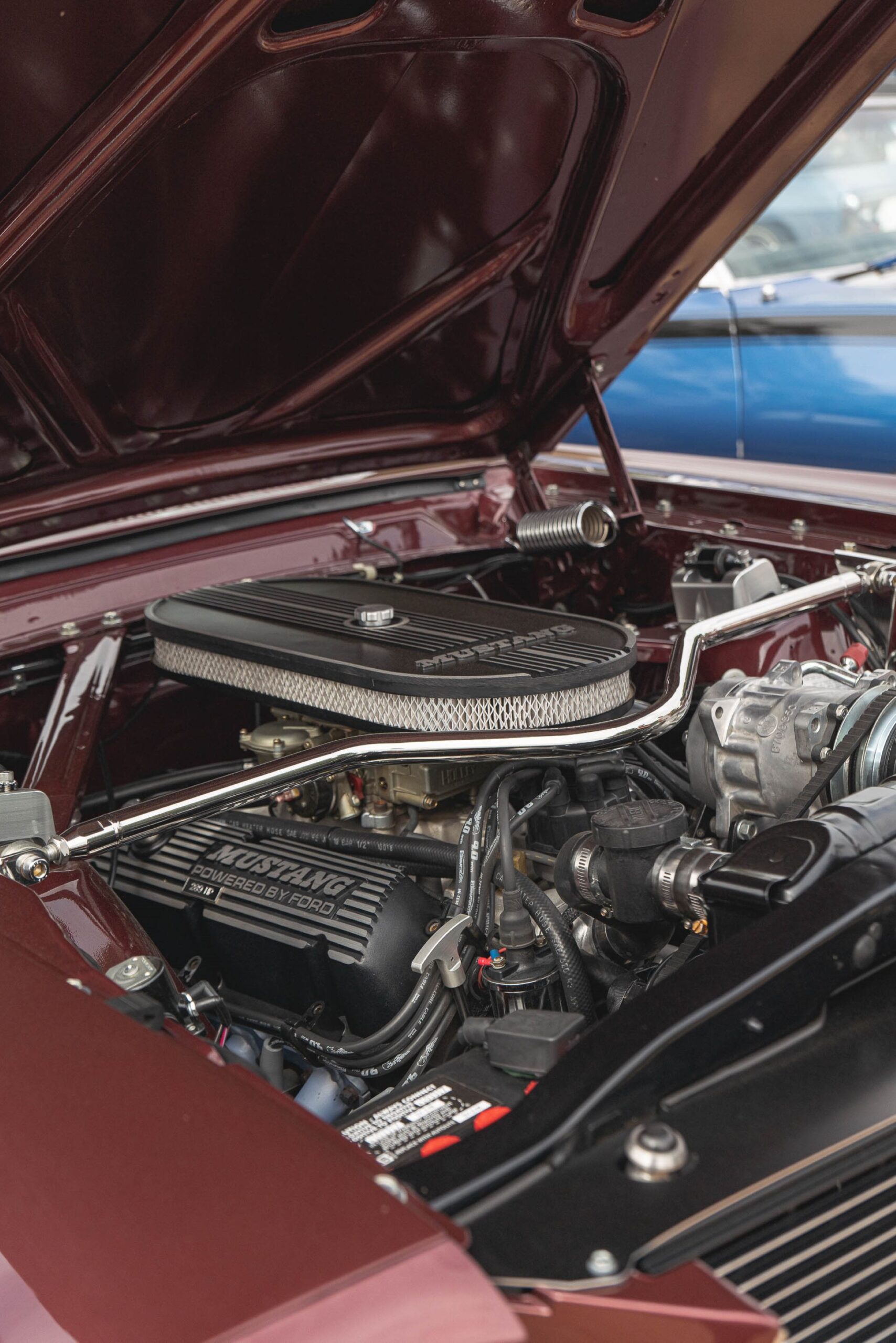
When the Dark Horse launched, we called it both a celebration and a eulogy for the naturally aspirated V8 pony car. Two years later the eulogy part came true faster than anyone expected: the Camaro is gone, the Challenger’s V8 went with it, and the Mustang now stands entirely alone as the last V8 pony car you can buy. That scarcity has done interesting things to the market — and if you’re shopping for a used Mustang Dark Horse in 2026, the numbers have a story to tell that’s very different from the Civic Type R’s.
Why the Dark Horse Still Matters: A Recap
The Dark Horse sits at the top of the seventh-generation (S650) Mustang lineup, packing a revised 5.0-liter Coyote V8 good for 500 horsepower — the most ever in a non-Shelby, GT-based Mustang. More importantly, it got the chassis hardware that finally made the Mustang honest on a road course: a GT500-derived strut tower brace, MagneRide adaptive dampers, and a standard Torsen limited-slip differential.
The manual is the heart of the car: a Tremec TR-3160 six-speed exclusive to the Dark Horse (the regular GT uses a different gearbox), with shorter throws than any previous Mustang and a genuinely useful no-lift-shift feature. A 10-speed automatic is the no-cost alternative, and — remember this for the used-market section — the transmission choice turns out to be the single biggest factor in what these cars are worth. Inside, Ford finally addressed the rental-grade trim of earlier generations with better materials and a configurable digital dash.
Used Mustang Dark Horse Prices in 2026
Here’s where it gets interesting. Per current KBB and Cars.com data:
- Dealer asking prices for used 2024s average about $64,700 — at or above what most of these cars stickered for new
- KBB private-party values run roughly $45,000–$51,400 depending on condition and miles — a spread of nearly $15,000–$20,000 below what dealers are asking for the same car
- Trade-in values sit around $43,600–$50,000, which explains the gap: dealers buy low from owners and list high on scarcity
That dealer/private-party spread is the entire buying strategy. Two forces created it. First, scarcity pricing: with the Camaro and Challenger dead, dealers treat every V8 Mustang — especially the halo trim — as a future collectible. Second, an oddity of the trade-in market: dealers genuinely dislike taking manual cars on trade because they’re slower to retail, so manual Dark Horses change hands cheap privately while wearing premium prices on dealer lots. The new supercharged Dark Horse SC arriving for 2026 pushes well into six-figure territory, which only reinforces dealer confidence that the standard car’s price floor is solid.
How to Buy One Right
Buy private party, and buy the manual. The private-party market is where the used Mustang Dark Horse actually costs what it should — high $40s to low $50s for a clean 2024 — instead of dealer-lot fantasy pricing. And the Tremec manual is both the better driving experience and the better long-term hold: it’s the transmission the collectors will want, on the last naturally aspirated V8 pony car, in the trim built for it. The 10-speed automatic is objectively quicker around a track, but it’s also the spec that will always be easier to find and cheaper to sell.
Negotiate dealer listings hard, or don’t bother. A dealer asking $65,000 for a car whose private-party value tops out around $51,000 is pricing for a buyer who doesn’t do research. You do — the KBB private-party number is your anchor, and inventory that’s aged 60+ days on a lot is where that argument works.
The Used Dark Horse Inspection Checklist
The Coyote V8 has a long, strong reliability record, and the S650 hasn’t shown systemic problems. What you’re really inspecting for is how the car was used — this is a track-capable halo trim, and plenty have been used exactly as advertised:
- Track history. Not disqualifying — the Dark Horse is built for it — but it must be priced in. Ask directly, look for tech stickers, harness marks, or brake pad/rotor combinations that don’t match street use, and treat “spirited weekend car” answers with appropriate suspicion. (Our track day guide shows what a well-prepped track car’s maintenance record should look like — documentation is a green flag, not a red one.)
- Clutch and gearbox (manuals). The TR-3160 is stout, but launch abuse shows up as slip under load and notchy 1-2 shifts when hot. Test both.
- MagneRide dampers. Adaptive dampers are excellent and expensive. Listen for clunks over sharp bumps and confirm the drive modes produce an obvious firmness change.
- Tires and brakes. A Dark Horse on bald rears and cooked pads tells you its life story. Factor a full refresh (~$2,500+) into any car that needs it.
- Tunes and mods. The Coyote responds beautifully to tuning, so many cars are tuned — and de-tuned before sale. Scan the ECU, and ask for the parts receipts if anything aftermarket is visible.
- The standard used-performance-car routine. History report, cold start, fluid check, independent inspection — the full list is in our used performance car buying guide.
The 2026 Context: Last One Standing
The Dark Horse’s position has only strengthened since launch. The manual-transmission revival we covered in Manual Transmissions Are Having a Moment is real, and the Dark Horse with the Tremec is its poster child at the V8 end of the market. If your taste runs naturally aspirated and track-focused with a bigger budget, the Porsche 911 GT3 remains the benchmark — but it plays in a different financial universe. In the Dark Horse’s actual price bracket, nothing else offers 500 naturally aspirated horsepower, three pedals, and a chassis this sorted. Nothing else can.
The Bottom Line
The Dark Horse was good when it launched; the market around it made it inevitable. In 2026 it’s the last of its kind, and the used market knows it — at least on dealer lots. The smart play is patient private-party shopping for a documented, unmolested Tremec car in the high $40s to low $50s, inspected like the track weapon it might have been. Buy it right, and you own the final chapter of the V8 pony car — a car whose depreciation curve has scarcity working permanently in your favor.
Pre-Purchase Inspection Kit
Two cheap tools that pay for themselves on a single used-car inspection:
- Bluetooth OBD2 scanner — stored codes, readiness monitors, and evidence of tuning
- Paint thickness gauge — finds resprays and bodywork a clean history report misses
As an Amazon Associate, Infinity City earns from qualifying purchases.